Your hurricane deductible isn't $1,000.Tu deducible de huracán no es $1,000.
Almost everyone knows their regular deductible. The hurricane one is different, it's a percentage, and it can be ten times bigger. Here's how to read it.Casi todo el mundo conoce su deducible normal. El de huracán es otro, se calcula como porcentaje y puede ser diez veces más grande. Así se lee.
Nov 12, 20267 min readFuente team · Doral12 nov 20267 min de lecturaEquipo Fuente · Doral
Your hurricane deductible appears in dollars on your dec page. Look it up before the season.Tu deducible de huracán aparece en dólares en tu dec page. Búscalo antes de la temporada.
The roof cost $14,000 to fix after the storm. You call the insurer and they tell you it's all on you. It's not a mistake: it's your hurricane deductible.
When you buy home insurance in Florida, you usually have two deductibles. One is for "all other perils" (AOP): a fixed amount, like $1,000 or $2,500, that applies to things like a fire or a burst pipe. The other is the hurricane deductible, and it's almost always a percentage of your dwelling limit.
You have two deductibles
Florida law requires insurers to offer hurricane deductible options of $500, 2%, 5% or 10% of the dwelling limit. There are nuances: if your home is insured for $250,000 or more, the insurer doesn't have to offer the $500 option, but it must offer 2%, 5% and 10%.
The key point: that percentage is calculated on your dwelling limit (Coverage A), not on the damage. That's why a 2% that sounds small can be a lot of money.
Good newsThe law also requires your hurricane deductible to appear in dollars on your policy's declarations page, even if you chose it as a percentage. You don't have to calculate it yourself.
The math on a real house
The math, written out
Doral home insured for $400,000 · hurricane damage: $14,000
2% deductible
$400,000 × 2%$8,000
Damage − ded.$14,000 − $8,000
Insurance pays$6,000
You pay$8,000
5% deductible
$400,000 × 5%$20,000
Damage − ded.$14,000 − $20,000
Insurance pays$0
You pay$14,000
With 5%, the premium is usually lower, but you pay a "medium" claim in full. With 2%, you pay more premium but insurance starts responding sooner. Neither option is right for everyone: it depends on how much you could pay out of pocket tomorrow if it happened.
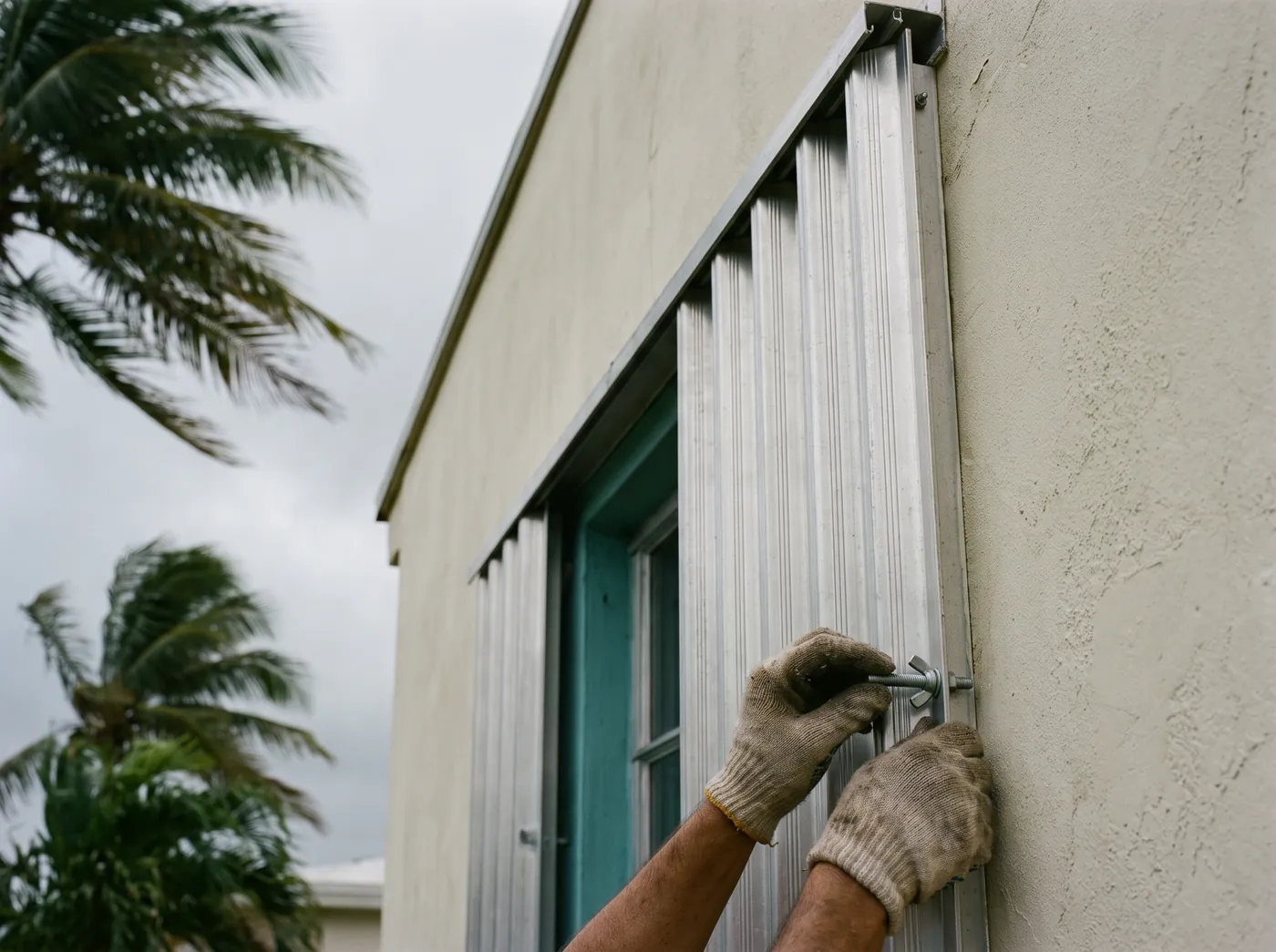
Shutters and other protections don't just protect the house: they can lower the wind portion of your premium.
When it applies (and when it doesn't)
It starts when the National Hurricane Center issues a hurricane warning for any part of Florida.
It ends 72 hours after the last hurricane watch or warning is lifted.
It's annual. On residential policies it applies once per calendar year. If a second hurricane hits the same year, you pay whatever was left of the first or your AOP deductible, whichever is greater.
It doesn't apply to rising water. The hurricane deductible is for wind damage. Flooding goes through a flood policy (read Wind and water are not the same).
A tip from Florida's Department of Financial Services: report damage even if it's below your deductible, so what you've already "paid toward" it is on record if another storm comes that year.
The discount almost nobody asks for
Florida law requires insurers to offer wind mitigation discounts or credits: things like your roof type, how it's tied to the walls, and whether windows and doors are protected. But they're not automatic: you have to prove them with a wind mitigation inspection on the state's official form (OIR-B1-1802).
If you replaced the roof or windows, or added impact doors, ask for a new inspection.
Send the form to your agent so it gets applied to your policy.
The discount is on the wind portion of the premium, and it varies by insurer.
What to check today
Open your dec page and find "Hurricane deductible": note the dollar amount.
Ask yourself if you could pay that amount tomorrow. If not, it's worth comparing options.
Find your last wind mitigation inspection. If you don't have one, or the house has changed, get one.
The takeaway
Your hurricane deductible is a percentage of your house, not of your damage. Know it in dollars before the season, not after the storm.
Questions about your policy?
We'll review it and compare options, no obligation.
This article is general information and doesn't replace reading your policy or advice from a licensed agent. Facts checked in November 2026; laws and requirements can change.
El techo te costó $14,000 arreglarlo después de la tormenta. Llamas al seguro y te dicen que te toca pagarlo todo. No es un error: es tu deducible de huracán.
Cuando compras un seguro de casa en Florida, normalmente tienes dos deducibles. Uno es el de “todos los demás riesgos” (All Other Perils, o AOP): una cantidad fija, como $1,000 o $2,500, que aplica a cosas como un incendio o una tubería rota. El otro es el deducible de huracán, y casi siempre es un porcentaje del límite de la vivienda.
Tienes dos deducibles
La ley de Florida obliga a las aseguradoras a ofrecer opciones de deducible de huracán de $500, 2%, 5% o 10% del límite de la vivienda. Hay matices: si tu casa está asegurada por $250,000 o más, la aseguradora no tiene que ofrecerte la opción de $500, pero sí las de 2%, 5% y 10%.
Lo importante: ese porcentaje se calcula sobre el límite de la vivienda (Coverage A), no sobre el daño. Por eso un 2% que suena pequeño puede ser mucho dinero.
Buena noticiaLa ley también exige que tu deducible de huracán aparezca en dólares en la página de declaraciones de tu póliza, aunque lo hayas escogido como porcentaje. No tienes que calcularlo tú.
La cuenta con una casa real
La cuenta, escrita
Casa en Doral asegurada por $400,000 · daño de huracán: $14,000
Deducible de 2%
$400,000 × 2%$8,000
Daño − ded.$14,000 − $8,000
El seguro paga$6,000
Pagas tú$8,000
Deducible de 5%
$400,000 × 5%$20,000
Daño − ded.$14,000 − $20,000
El seguro paga$0
Pagas tú$14,000
Con el 5%, la prima suele ser más baja, pero un daño “mediano” lo pagas completo. Con el 2%, pagas más prima pero el seguro empieza a responder antes. Ninguna opción es correcta para todos: depende de cuánto podrías pagar de tu bolsillo mañana si pasa.
Los paneles y otras protecciones no solo cuidan la casa: pueden bajar la parte de viento de tu prima.
Cuándo aplica (y cuándo no)
Empieza cuando el Centro Nacional de Huracanes emite un aviso (warning) de huracán para cualquier parte de Florida.
Termina 72 horas después de que se levante el último aviso o vigilancia de huracán.
Es anual. En pólizas residenciales aplica una vez por año calendario. Si en el mismo año llega un segundo huracán, pagas lo que te faltó del primero o tu deducible AOP, lo que sea mayor.
No aplica al agua que sube. El deducible de huracán es para daño de viento. La inundación va por la póliza de flood (lee Viento y agua no son lo mismo).
Un consejo del Departamento de Servicios Financieros de Florida: reporta el daño aunque sea menor que tu deducible, para que quede registrado lo que ya “abonaste” en caso de otra tormenta ese año.
El descuento que casi nadie pide
La ley de Florida obliga a las aseguradoras a ofrecer descuentos o créditos por mitigación de viento: cosas como el tipo de techo, cómo está amarrado a las paredes y si las ventanas y puertas tienen protección. Pero no son automáticos: tienes que demostrarlos con una inspección de wind mitigation en el formulario oficial del estado (OIR-B1-1802).
Si cambiaste el techo, las ventanas o pusiste puertas de impacto, pide una inspección nueva.
Envía el formulario a tu agente para que lo apliquen a tu póliza.
El descuento es sobre la porción de viento de la prima, y varía por aseguradora.
Qué revisar hoy
Abre tu dec page y busca “Hurricane deductible”: anota el número en dólares.
Pregúntate si podrías pagar esa cantidad mañana. Si no, vale la pena comparar opciones.
Busca tu última inspección de wind mitigation. Si no tienes una, o la casa cambió, pide una.
Para llevar
Tu deducible de huracán es un porcentaje de tu casa, no de tu daño. Conócelo en dólares antes de la temporada, no después de la tormenta.
¿Dudas sobre tu póliza?
Te la revisamos y comparamos opciones, sin compromiso.
Este artículo es información general y no sustituye la lectura de tu póliza ni la asesoría de un agente licenciado. Datos verificados en noviembre de 2026; las leyes y requisitos pueden cambiar.
Questions about your policy?¿Dudas sobre tu póliza?
We'll review it with you.La revisamos contigo.
A Doral agent compares several insurers for you, in English or Spanish. No obligation.Un agente en Doral compara varias aseguradoras por ti, en español o en inglés. Sin compromiso.